
Workshops, Symposium, & Events
Join us during the academic year for workshops where our SVSU colleagues share their expertise and experience.
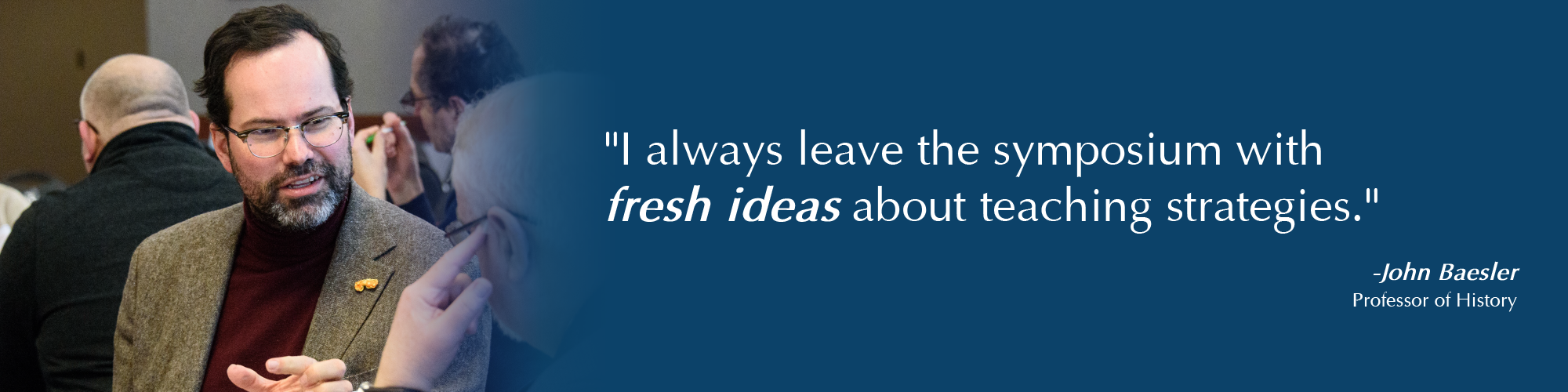
In October, CETL hosts an annual Teaching and Learning Symposium that explores a single theme and showcases innovative teaching and scholarship from SVSU faculty.
Symposium 2026
October 2026 Teaching and Learning Symposium:
Reclaiming Attention
Friday, October 23
Emeriti Room
Reclaiming Attention is the theme of CETL’s 2026 Symposium, an exploration of the competing pressures that are straining higher education: expanding AI tools, constant digital distraction, student calls for “relevancy,” growing mental fatigue, and renewed interest in digital minimalism and deep work. In this environment, how can we reclaim attention for meaningful teaching? Should we slow down? Redesign? Double down on human presence? Or mindfully lean into digital tools to sharpen focus and relevance? Join us for a day of thoughtful conversation around these questions that will feature:
Schedule
8 am: Breakfast
9:15 An Oxford-Style Debate. Colleagues from across disciplines will debate a timely resolution (currently framed around whether SVSU should prioritize slower, more digital-light learning experiences in response to AI-driven acceleration). Audience members will vote before and after the debate, followed by discussion and sharing of teaching strategies.
11:30 Pecha Kucha session featuring SVSU’s Dow Professor Award Winners. The faculty presenters will showcase ways emerging technologies can make learning more engaging and visibly connected to students’ futures.
12:00 Lunch
1:00 Workshops. Two workshops facilitated by the 2026/27 Faculty Learning Community members will invite deeper exploration of practical strategies for reclaiming attention:
- 1:00, CCB 216, Career Readiness – Approaches to embedding career competencies and real-world relevance into courses in ways that enhance engagement and focus rather than add stress or surface-level “add-ons.”
- 2:00, CCB 217, Not All Lectures Are Equal –Methods for designing and delivering lectures that sustain attention, deepen understanding, and expand your lecture toolkit without abandoning a teaching method that still has real power.
Whether you are concerned about digital distraction, intrigued by AI’s possibilities, committed to slow learning, or seeking new ways to connect coursework to professional pathways, the 2026 CETL Symposium offers space to think carefully and collectively about what deserves our students’ attention. Mark your calendar now and plan to join the conversation!
Workshops
CETL runs workshops on teaching and learning topics throughout the year. Register for our events at the University workshops page, under Academic Affairs.
Want to access materials from previous workshops? They are archived on our Canvas site's workshops page.
Fall 2026 Workshops
Micro-Moments of Calm: Supporting Attention and Learning in Class
Diane Deacon (English) and Katrina Kreichelt (Nursing)
Attendees will practice brief, low-stakes relaxation techniques-- including guided breathing, posture shifts, and short mindfulness exercises-- that can be integrated into any class session without sacrificing instructional time.
Yoga pants encouraged!
Tuesday, September 15, 2027 • GN 103 • 1:00 to 2:00 PM
Less but Better: Simplifying Course Design for Learning and Wellbeing
Missy Hobart (Communication)
Attendees will learn practical strategies for simplifying course design-- from reducing unnecessary content to streamlining feedback practices-- that improve engagement while lowering stress.
Monday, October 5, 2026 • Zahnow 223B • 10:00 to 11:00 AM
Designing for Belonging: Building Strong Online Learning Communities
Jennifer Ward and Holly Long (Teacher Education)
Attendees will explore practical ways to design online asynchronous courses so students feel connected and valued as contributing members of the classroom community.
Wednesday, November 11, 2026 • GN 103 • 11:00 AM to 12:00 PM
Winter 2027 Workshops
Beyond the “Fix”: Cultivating Student Agency with Grammarly and AI
David Berry (Kinesiology)
Participants will explore strategies for integrating an “Authorship-First” approach that encourages students to critically assess AI suggestions for tone, clarity, and professional impact.
Monday, January 25, 2027 • Zahnow 223B • 1:00 to 2:00 PM
Hybrid Courses in an AI Age: Adjusting the Online Modality for Deeper Learning
Aneesha Gogineni (Mechanical Engineering) and Anne Huebel (CETL)
This workshop demonstrates how hybrid courses can respond to the challenge of whether students are using AI to complete work. Participants will also explore project-based learning, industry-connected assignments, and industrial tours.
Friday, February 19, 2027 • Zahnow 223B • 10:00 to 11:00 AM
Competitive Academic Experiences as High-Impact Practices: Engagement Without Burnout
Ryan Rigda (Communication), Kevin Lorentz (Political Science), Amy Hendrickson (Law), Peter Rose-Barry (Philosophy), Amy Pierce (Communication), and Brooks Byam (Mechanical Engineering)
This workshop explores High-Impact Practices, grounded in research on experiential learning, deliberate practice, and student engagement.
Friday, April 2, 2027 • GN 103 • 10:00 AM to 12:00 PM