
Winter 2026 BFA Exhibition: Fracture
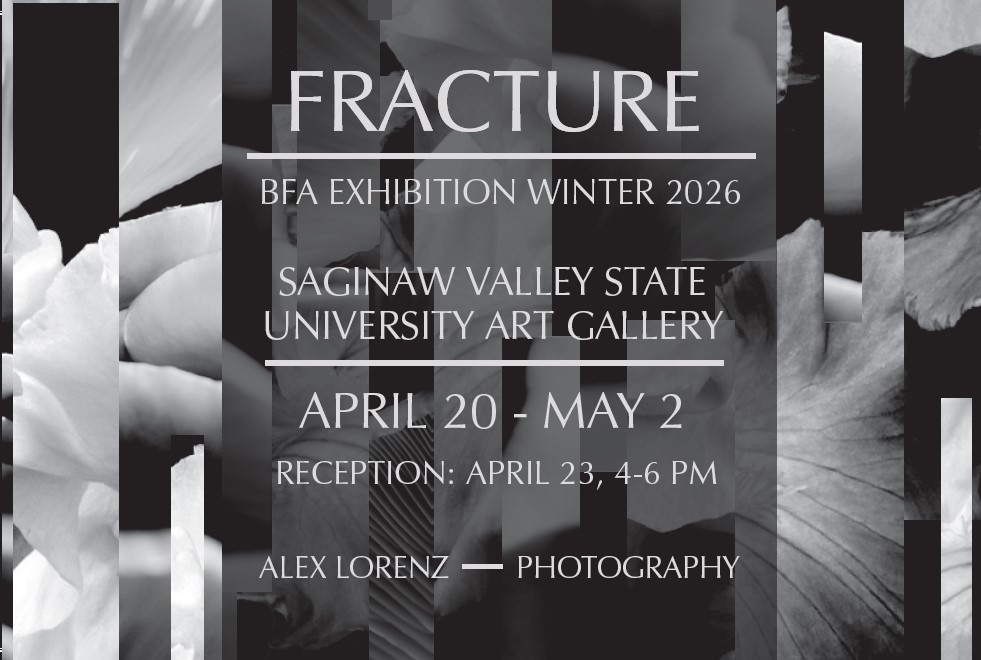
April 20th - May 2
Reception : April 23, 4 - 6 p.m.
Senior BFA Candidate Alex Lorenz presents their body of work as the culmination to the BFA in Art degree criteria. Alex works in photography and painting and drawing and their work has been recognized as award winning in many regional art exhibitions. Join Lorenz at their gallery reception April 23 from 4-6 pm. The reception is free and open to the public.
Alex Lorenz Artist Statement
With my art I want people to consider things in a way they haven’t before. To take the time
to understand something in a new context in a world that tends to move very quickly. I do
this by subverting expectations, capturing images that show recognizable subjects in a
unique or abstracted way. Through the art I create I’m specifically interested in how partial
abstraction can cause a viewer to react to the content of a piece as opposed to how they
would if I just depicted it in its entirety. For example, nature is generally regarded as
beautiful. If I put a natural subject in an unnatural or geometric composition, does that take
away its beauty or make it a less compelling subject? In many of my pieces I play with this
idea by taking at least two images and separating them into different geometric planes and
then placing them into a composition together.
I started creating work related to this theme in other media before photography.
The first work I made like this was a pencil drawing, shortly after that I moved onto
inkwash, and also started creating collages with digital and film photographs. Although my
main focus is photography, I am currently making paintings that help me focus on slightly
different techniques to express my ideas in different media. While the two media,
photography and painting, are different, there are some aspects that I focus on in both.
Form and value are especially important to me when choosing images and creating
compositions for all of my pieces. A majority of my work is in black and white because I feel
my focus on form and value is better highlighted in monochrome. I also feel that the lack of
color, in most instances, makes the forms in my pieces more abstracted; forcing the viewer
to consider them for longer than if they were in full color.
When I am creating photo collages I typically start with planning out a geometric
composition. Either by hand or on a computer I size out the rectangular shapes and decide
how they’re going to overlap, taking careful consideration to make sure it’s balanced. I then
select the photographs to use, normally two or more, based on contrasting subject matter,
form, and/or texture. The next thing I do is divide up the images and arrange them within
my composition. Sometimes I do this by digitally cropping photos, other times I print the
images in full and cut them by hand for more dimensional pieces. I have also made collages
directly in the darkroom, which required me to make at least 3 separate hand-cut masks
per collage and expose my photopaper multiple times before development. My approach to
making darkroom photocollages using masks comes from the artist Jerry Uelsmann. When
creating in the darkroom, he sets up multiple enlargers with his images and masks and
transfers his photopaper between them, doing multiple exposures before developing. I
used the same idea, but changed out the negatives and masks between exposures so I
would only be using one enlarger instead of multiple.
My painting process starts with the same collage making techniques. However, once
I’m done with the digital collage I sketch it out and paint it onto watercolor paper. When
I’m painting I focus on further abstracting the sections of the images by leaning into the
fluidity of the inkwash. I tend to depict areas smoother than they appear in the photos. I
occasionally will increase the contrast in areas of the painting where images interact with
each other. Doing both of these things further abstracts the images in an effort to make the
viewer consider the subjects longer. I draw inspiration for my geometric compositions that
fragment images from painter David Hockney. He has several photo collages that I find
mirror my theme of wanting to show recognizable objects in a unique way. I also am
influenced by the painter Georgia O’Keeffe. I admire the way she partially abstracts floral
forms and how fluid her watercolor paintings are.
Contact Us
gallery@svsu.edu
(989) 964-2291(989) 964-2291
UAG Coordinator
Department of Art
Blake Johnson, Chair
Office
University Art Gallery
Arbury Fine Arts Center
Contact Us:
To be added or removed on
postal mail or email:
gallery@svsu.edu