
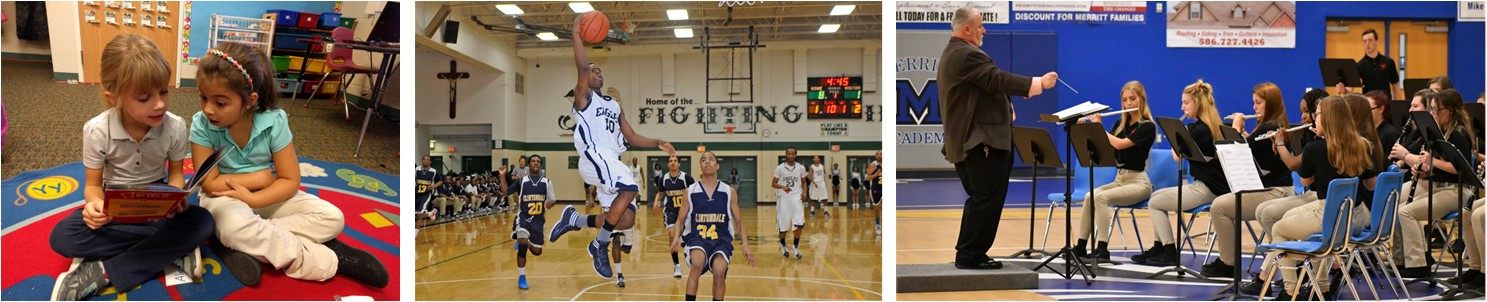

A PSA is a state supported public school. A PSA may include grades K-12 or any combination of those grades.
The Revised School Code, 1995 Public Act 291, Part 6A.
"Sec. 501. (1) A public school academy is a public school under section 2 of article VIII of the state constitution of 1963, is a school district for the purposes of section 11 of article IX of the state constitution of 1963 and for the purposes of section 1225, and is subject to the leadership and general supervision of the state board over all public education under section 3 of article VIII of the state constitution of 1963. A public school academy is a body corporate and is a governmental agency. The powers granted to a public school academy under this part constitute the performance of essential public purposes and governmental functions of this state."
For the purpose of state aid and federal funding, a PSA is considered a local district. For the purpose of the Revised School Code and federal mandates, a PSA is also considered a public school building.
An authorizing body is a public educational institution that has been granted the power to issue contracts to those interested in establishing and operating a PSA. Authorizing bodies include boards of:
"Sec. 504. (2) A public school academy shall not charge tuition and shall not discriminate in its pupil admissions policies or practices on the basis of intellectual or athletic ability, measures of achievement or aptitude, status as a handicapped person, or any other basis that would be illegal if used by a school district. However, a public school academy may limit admission to pupils who are within a particular range of age or grade level or on any other basis that would be legal if used by a school district."
Certification requirements for PSA teachers are identical to those of local school district teachers. Special exceptions are made for a PSA that is operated by a state university or community college that may wish to use collegiate staff to teach PSA students.
No. A PSA must maintain the separation between church and state.
A PSA is funded through the State School Aid Act. A PSA receives funding through the per pupil base foundation. By law, this amount may not exceed the per-pupil base foundation received by the local school district where the PSA is geographically located.
No. The transportation of students is the responsibility of the PSA.
Yes, the only exception is in the case of an expulsion. Expulsions should be handled on an individual basis.
Yes, the only exceptions are when a PSA has reached their enrollment capacity or in the case of an expulsion. Expulsions should be handled on an individual basis.
Charter public schools are required to offer services to students with special needs and may operate the special education program or service, contract with another public education entity, and/or contract with the outside companies for the provision of instructional services.
Charter public schools are independent schools districts with autonomy in choosing curriculum, teaching styles and missions. Charter public schools receive increased autonomy in exchange for stricter accountability to a variety of sources including the authorizing body that sponsors them, the parents that choose them, and the public that funds them.